What To Do When Everything Goes Wrong At Once.
I still have the letter.
January 7, 1988. Two pages, typewritten. My signature at the bottom. A Statement of Purpose addressed to the Department of Theatre, Film, and Television at UCLA — Screenwriting program.
I was broke. Homeless in the sense that “home” was a very temporary arrangement. My financial statement to the university was essentially three sentences: I have no money. I have survived worse. Call the credit union if you don’t believe me.
And my heart was breaking in ways I couldn’t put on paper.
My sister was in the UCLA Neuropsychiatric Institute. The doctors were filling her with drugs that we didn’t yet know were doing more harm than good — drugs that would eventually be recognized as suicide-provocative. I was terrified of losing her. I was already losing her, in the slow, quiet way that happens before you know it’s happening.
I wrote that letter anyway. I made it funny. I made it alive. I made it myself.
They let me in.
Here is what I have learned in the thirty-eight years since: comedy only comes from deep pain, not as an escape from pain, but as its most honest translation. The funniest letter I ever wrote came out of the worst season of my life. That is not a coincidence. That is how it works.
THE SECRETARY WHO UNDERESTIMATED ME
Before I applied, I walked into the UCLA Film School office and asked a simple question: What does it take to get in?
The secretary looked me up and down — took in the full picture — and said flatly: “Two thousand people apply. We admit twenty.”
The implication was clear. I would not be one of the twenty.
I thanked her, went home, and wrote the best letter I’d ever written.
She later became a dear friend. We’ve laughed about that moment many times. But I’ve never forgotten what she gave me in that instant: the most useful fuel there is. She underestimated me.
It is always good to have people underestimate you.
BUT FIRST, I HAD TO GRADUATE
What the letter doesn’t mention is everything that had to happen before I could write it.
I had left UC Berkeley in 1970, planning to spend three months in New York City studying with Stella Adler. I stayed eleven years. When I finally came back to Los Angeles and decided I wanted that UCLA program, I went to Murphy Hall to ask about applying.
They told me I couldn’t. Not because I wasn’t qualified — but because I didn’t have an undergraduate degree. And I couldn’t get one from UCLA because I had too many units at Berkeley.
So I had to go back to Berkeley first. Graduate. Then apply to UCLA. Not knowing whether UCLA would ever consider me. Not knowing if any of it would work.
I moved back to Berkeley on essentially no money, enrolled in 28 units of undergraduate coursework, and finished in eight months.
And those eight months were magical. I was broke, exhausted, and completely uncertain about my future — and I danced every Friday night with a 20-year-old. Joy is not the reward you get after surviving hard things. Joy is how you survive them. Fun is a strategy, not a luxury. Don’t let anyone tell you otherwise.
I lived by a Goethe couplet that year, and I still do:
Whatever you can do or dream you can, begin it. Boldness has genius, power, and magic in it.
WHAT THE LETTER DOESN’T SHOW
The Statement of Purpose opens with a story about performing a strip in an Off-Off Broadway theatre for an audience of elderly residents from the House of Zion Home for the Aged, “a capella and off-key,” while someone backstage whispered, “Cardiac arrest in row five.”
It’s funny. It’s alive. It sounds exactly like me.
What it doesn’t show is what was happening when I wrote it. I’m telling you now because I think it matters — because I think you may be in your own version of January 1988 right now.
I did not wait for the grief to resolve before I acted. I acted inside the grief. I made jokes inside the grief. I signed my name at the bottom of two typewritten pages, walked to the mailbox, and let it go.
That is the whole lesson. That is everything I know about forward motion.
YOU DO NOT HAVE TO FEEL HOPEFUL IN ORDER TO ACT HOPEFULLY
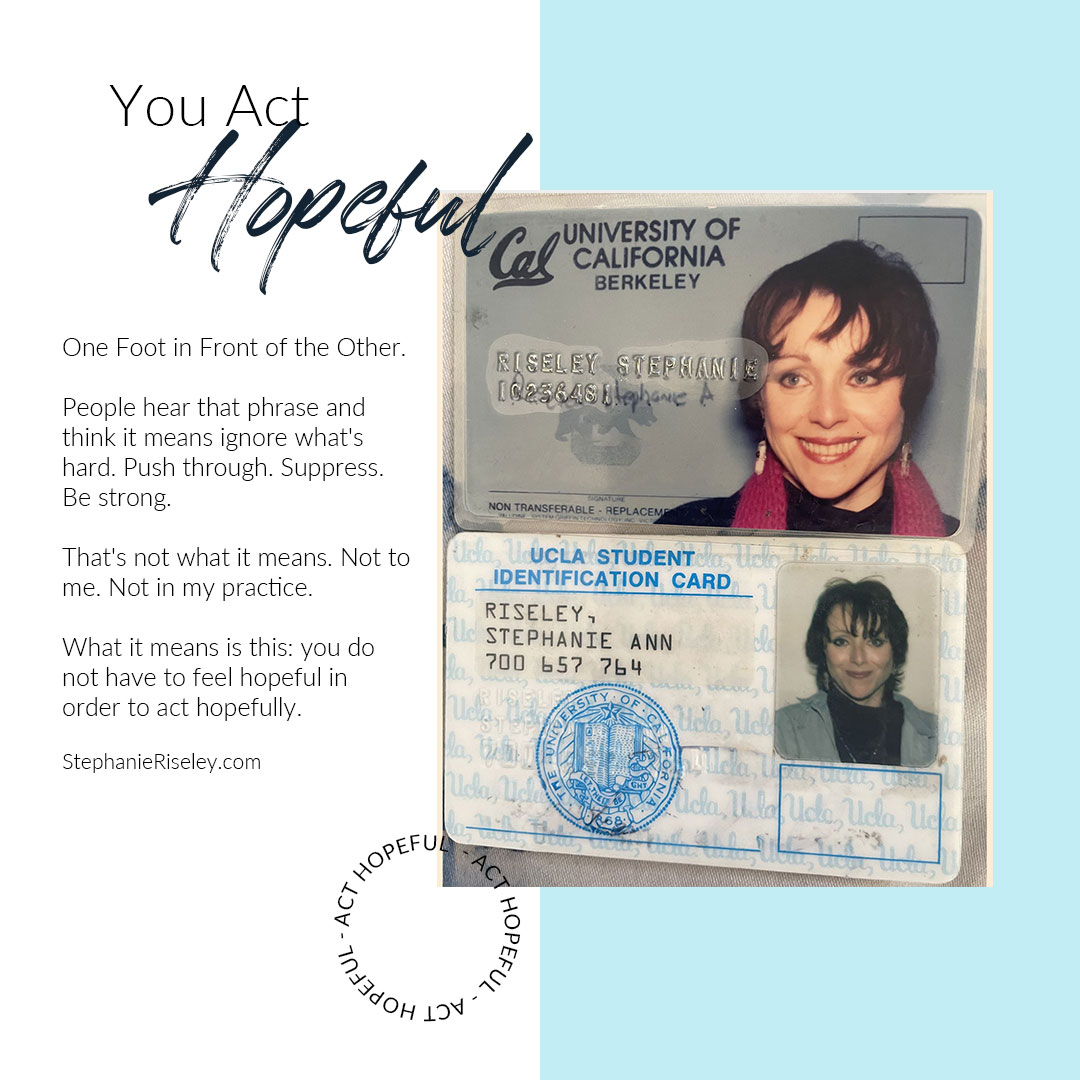
People hear “one foot in front of the other” and think it means ignore what’s hard. Push through. Suppress. Be strong.
That’s not what it means. Not to me. Not in my practice.
What it means is this: you do not have to feel hopeful to act hopefully.
The letter I wrote to UCLA was hopeful. My circumstances were not. Those two things existed at the same time, in the same woman, on the same January afternoon.
Grief and forward motion are not opposites. They can share the same space. Comedy and heartbreak can live on the same two pages. They often do, when the writing is true.
The question isn’t: how do I stop hurting so I can move forward?
The question is: what is the next right action, right now, regardless of how I feel?
Sometimes it’s writing a letter. Sometimes it’s making one phone call. Sometimes it’s just getting dressed.
THE NEUROSCIENCE OF KEEPING GOING
Here’s what I know from more than twenty-five years of working with clients as a hypnotherapist and Cognitive Behavioral practitioner:
Your nervous system does not distinguish between imagined forward motion and real forward motion. When you take an action — even a small one — your brain begins to update its story about who you are and what’s possible.
Every step forward, however small, creates a new neural pathway. You are literally rewiring yourself by acting.
This is why hypnotherapy works so beautifully in moments of crisis or apparent stuckness. We bypass the conscious mind’s insistence that everything must be resolved before anything can begin, and go directly to the subconscious — where the blueprint of your capability lives, untouched by whatever storm is currently happening on the surface.
Past-life regression takes this even deeper. When clients see themselves having navigated impossible circumstances in other lifetimes — surviving, adapting, building — something fundamental shifts. The felt sense of I have done hard things before becomes real, not just an idea. The soul’s resilience becomes a memory rather than a hope.
That is a different kind of knowing. And it changes everything.
WHAT I TELL MY CLIENTS
I don’t just tell people to keep going. Anyone can say that.
I tell them: I kept going. Here is the evidence. Here is my signature. January 7, 1988. Written in the worst season of my life, funnier than anything I’d written before, because that is what pain does when you refuse to let it silence you.
Four months later, a dean named Victoria Fromkin signed an acceptance letter with my name on it.
Not because I had it together. Because I wrote the letter anyway.
That’s what I ask of my clients. Not perfection. Not resolution. Not the absence of pain.
Just the next action. Just the letter. Just this moment, right now, with whatever you have.
You have more than you think.
READY TO TAKE YOUR NEXT STEP?
If you’re in a place where forward motion feels impossible — where grief or fear or exhaustion has convinced you that the timing isn’t right, that you aren’t ready, that you should wait until things settle —
I’d love to talk.
Through hypnotherapy, Cognitive Behavioral Methods, and past-life regression, we work together to access the part of you that already knows how to keep going. The part that has always been known.
Please give me a call. (323) 933-4377
Because sometimes the most important letter you write is the one that asks for help.
Sending hope and love,
Stephanie
My Audios & Ebooks
All Audios and Ebooks are Instantly Downloadable